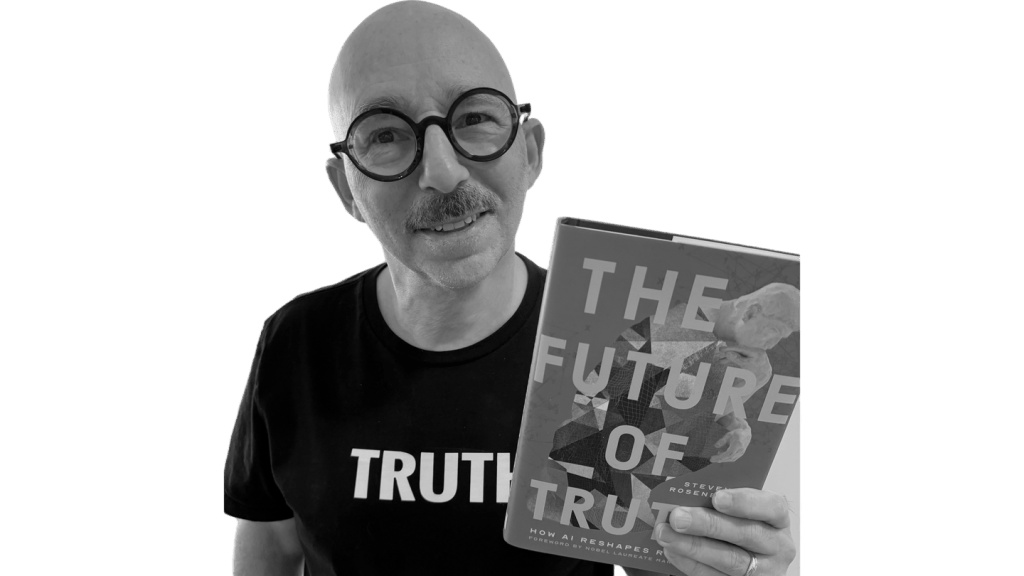
THE FUTURE OF TRUTH, HOW AI SHAPES REALITY was pulled from digital bookshelves in May after The New York Times discovered it contained AI-fabricated quotes. In a bizarre twist, the revised edition contains whole paragraphs lifted without attribution from news coverage of the scandal.
“I think I’m the leading inquisitor in the quest of truth in society, and that’s a role that I’m going to take seriously.” That is how Steven Rosenbaum, regional Emmy winning author and filmmaker, described himself last month on the YouTube podcast Keen On, where he pushed back against New York Times reporting that his latest book falsely attributed AI-fabricated quotes to the likes of tech journalist Kara Swisher and Northeastern professor Lisa Feldman Barrett.
But his glowing self-appraisal might be short-lived. Reading the ebook version of The Future of Truth (Revised Edition)—published with new material by Matt Holt Books (an imprint of BenBella Books) and distributed by Simon and Schuster—I found huge chunks of verbatim copying and wholesale rewrites of news articles, including improperly attributed quotes from interviews he never conducted. Incredibly, many of these additions were seemingly introduced during the book’s rewrite—with some of it lifted straight from news reports of Rosenbaum’s original blunder.
Take, for example, Page 164, Chapter 21, where Rosenbaum warns about the potential dangers of using AI in academic work:
“That near-miss sent Topaz on a mission. If it happened to him, how many other experts were having their work undermined by hallucinations? So, he did what researchers do. He ran the study. Topaz and his colleagues audited nearly 2.5 million biomedical papers and 97 million citations indexed on PubMed Central, the database clinicians and researchers rely on worldwide. The results, published in The Lancet, were profoundly disturbing. The audit turned up more than 4,000 fabricated references buried across nearly 3,000 papers. It’s impossible to know how many came from AI. Humans make things up too. But the curve tells the story: the steady rise in fake sourcing went vertical in 2024, just as AI tools entered widespread use in research. The numbers, as reported by Fortune, are stark. Over the past three years, the rate of fabricated references in biomedical literature has grown more than twelve-fold. In 2023, one in 2,828 papers contained at least one fake reference. By 2025, it was one in 458. In the first seven weeks of 2026, it was one in 277. And Topaz suspects the audit caught only a fraction of the problem.”
This passage lifts heavily from a May 2026 Fortune article titled “AI hallucinations are infiltrating expert work—and entering the permanent body of knowledge,” excerpted here for comparison:
“That near-miss sent Topaz on an investigation to find out how often experts were getting subtly fooled by AI. The answer, it turns out, is a lot. In a study published earlier this month in The Lancet, Topaz and his colleagues audited nearly 2.5 million biomedical papers and 97 million citations indexed on PubMed Central, the central repository used by clinicians and researchers worldwide. They found more than 4,000 fabricated references buried across nearly 3,000 papers. Not all the references were AI-generated, though Topaz said the steady rise in fake sourcing went ‘vertical’ in 2024, shortly after AI tools in research entered more widespread use. ‘It’s very reasonable that AI is highly associated with them now,’ he said. Over the past three years, the rate of fabricated references in biomedical literature has grown more than 12-fold. In 2023, one in 2,828 papers contained at least one fake reference, a rate that had risen to one in 458 by last year. Over the first seven weeks of 2026, the researchers found, one in 277 papers had at least one non-existent reference.”
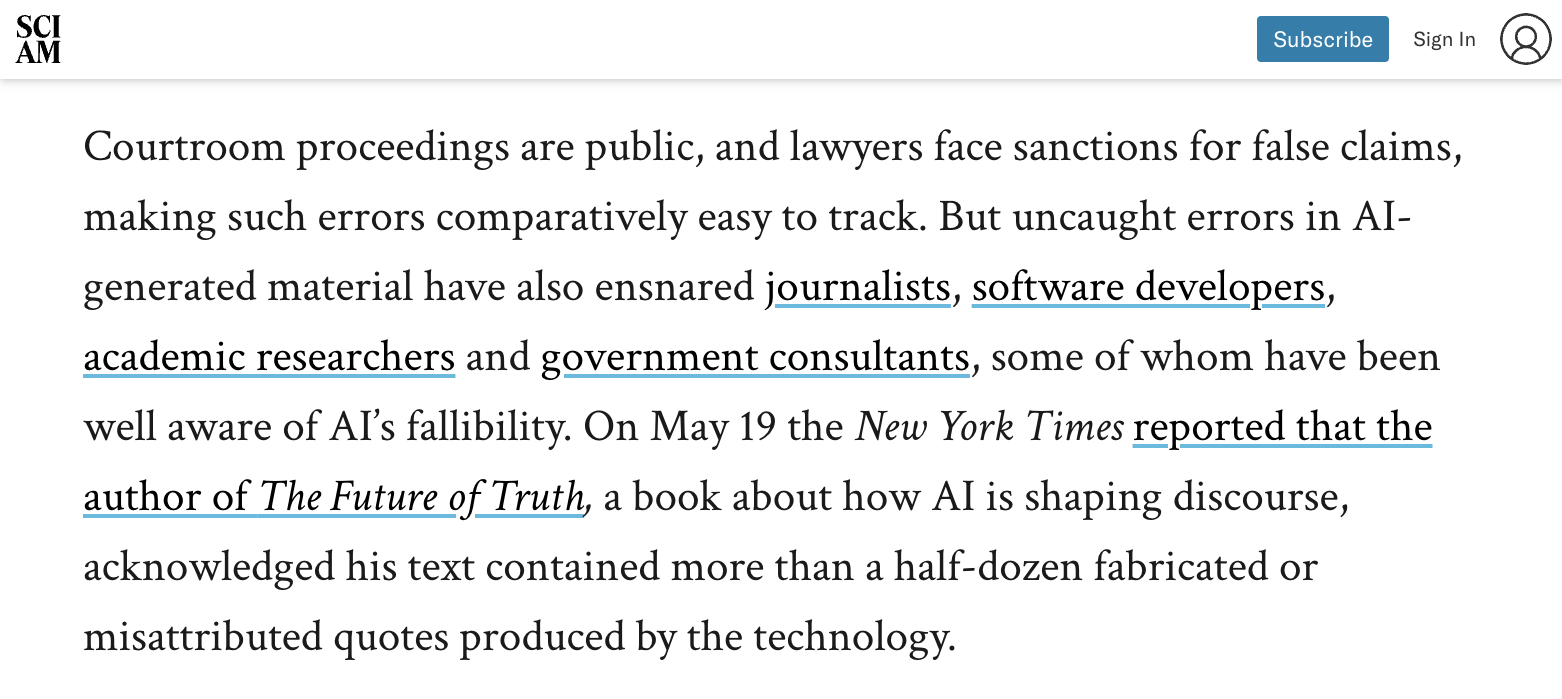
In a surreal turn, the Fortune article prominently covers, along other rogue AI case stories, Rosenbaum’s own book scandal, which he clearly omits from his rewrite.
The meta-plagiarism continues on Page 165, where Rosenbaum includes this sentence:
“Courtroom proceedings are public, and lawyers face sanctions for false claims, so these errors are comparatively simple to track.”
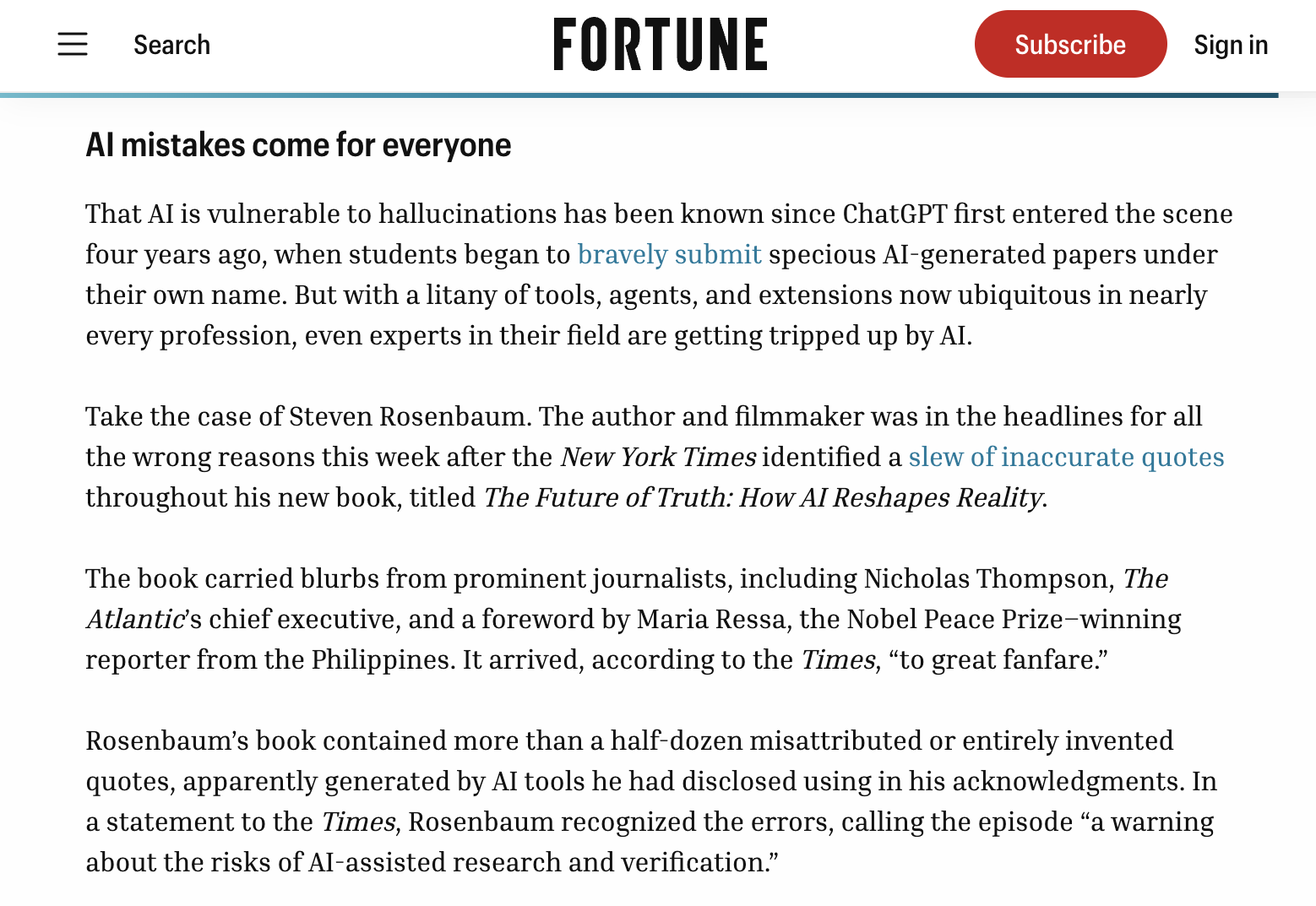
He seemingly lifted this line, near-verbatim, from “AI keeps inventing fake cases. Lawyers keep citing them,” published in Scientific American three days after the Times broke its story:
“Courtroom proceedings are public, and lawyers face sanctions for false claims, making such errors comparatively easy to track.”
Once again, Rosenbaum’s chosen source material prominently highlights his own AI struggles, this time within the very paragraph he copied from.
While Rosenbaum cites both the Fortune and Scientific American articles in his bibliography, verbatim copying and near-verbatim patchwriting still requires quotation marks and in-text attribution, according to Plagiarism Today founder Jonathan Bailey.
“Pretty much in any environment, you have an obligation to cite your information and your words,” Bailey tells me in an email. “If you use information without the words, you use a link, an in text citation or something similar. If you use the words, you need to quote it, block quote it or somehow indicate that the words are not original.”
Former executive editor of The New York Times Jill Abramson learned this lesson the hard way. Faced with similar allegations over her 2019 book Merchants of Truth (also published by Simon And Schuster), she directed news outlets—including The Washington Post—to the extensive citations in her endnotes as proof that her sourcing was kosher. But this did not shield her from criticism because, like Rosenbaum, she had not made clear which words were hers and which were not.
Further examples of potential plagiarism in Rosenbaum’s book include this excerpt from Page 141, Chapter 18, which was also included in the first edition:
“Three decades ago, Sir Tim Berners-Lee devised simple yet powerful standards for locating, linking, and presenting multimedia documents online. As he details in his book Weaving the Web, he released the World Wide Web freely to humanity. While others built Internet fortunes, Berners-Lee instead became the guardian of the technical standards meant to help the web thrive as an equal-access platform for connection and knowledge. Today, Berners-Lee believes the online landscape has lost its way. He argues that excessive power and personal information have become concentrated within technology giants like Google and Facebook, which he refers to as ‘silos.’ These companies, powered by enormous data collections, have evolved into surveillance systems and barriers to innovation. Regulators share these concerns, with Google and Facebook facing antitrust challenges and stricter privacy legislation in Europe and parts of the United States.”
The text appears to mirror a 2021 post by Spanish tech blog desdelinux, which is not listed in the bibliography or acknowledged in the text:
“When Tim Berners-Lee, then a computer scientist at CERN (European Organization for Nuclear Research), created the Web 30 years ago, he designed it around simple but powerful standards for locating, linking, and presenting multimedia documents online. Later, others capitalized on his creation and became billionaires through internet companies, including Google, Facebook and social media in general, Amazon, and Apple. Meanwhile, Berners-Lee has become the guardian of the technical standards designed to help the Web thrive as an egalitarian tool for connecting and sharing information. But today, Berners-Lee, 65, believes the online world has gone astray and has been revealing for the past few years that internet giants like Facebook and Google, which he calls ‘silos,’ have become hungry for data, always with the goal of accumulating more data and power. Fueled by vast amounts of data, they have become monitoring platforms and guardians of innovation. Regulators in the United States and elsewhere are thinking the same way and have begun adopting increasingly stringent data protection rules.”
It’s unclear how and when any plagiarised material was introduced to the revised book, as neither Rosenbaum nor his publishers replied to my comment requests. In a newly written introduction, Rosenbaum states that he worked for months with “an independent fact-checker” to fix the original text, “reviewing the manuscript line by line, citation by citation, and quote by quote” before isolating the problem: “in too many places,” he tenders, “AI had crossed an editorial line, right in front of me and I hadn’t recognized it.” From there, he says he “did something almost irresistible” and “asked ChatGPT” to help him “understand what had happened”—ultimately receiving an answer that “surprised” him and “framed the problem more clearly than I had been able to.”
“I haven’t walked away from AI,” he discloses at the end of said introduction.
In addition to potential plagiarism, Rosenbaum’s revised book at times appears to give the impression that he conducted interviews he had nothing to do with. For example, on Page 143, Chapter 18, he writes about Poppy Watson, a University of New South Wales lecturer:
“Dr. Poppy Watson, whose research explores how environmental cues shape attention, motivation, and decision-making, cautions against blaming social media alone for declining cognitive health. While excessive digital consumption may contribute to distraction and mental fatigue, she argues that the evidence does not yet support a direct causal link. ‘There are other factors that affect your brain health and your cognitive control, beyond social media,’ Watson explains, pointing instead to factors such as poverty, diet, and access to education as stronger predictors of long-term cognitive function. Watson points to the Flynn Effect, the steady rise in average IQ scores.”
This section seemingly mirrors reporting by University of New South Wales author Lachlan Gilbert, who interviewed Watson for a 2024 piece published to the university’s website. However, except for in the bibliography, Rosenbaum does not identify Gilbert’s article as the source of Watson’s remarks.
In another example on Page 134, Chapter 16, Rosenbaum seemingly gives the false impression that he retrieved the following quote directly from American media expert Douglas Rushkoff:
“Describing the purpose of his book Team Human, [Rushkoff] explained: ‘Team Human is almost a piece of literary software. It’s meant as an experience through which people can embed their brain with a programme that will help them resist the manipulative algorithms, platforms and systems that are out there.’ The challenge, Rushkoff argues, is not merely to question whether information is true, but to recognize how the digital systems that deliver it increasingly influence what we believe in the first place.”
In fact, he took it from a 2020 interview Rushkoff gave to the New York activist magazine Good Trouble. Again, this is only mentioned in the bibliography.
Elsewhere in the book, Rosenbaum’s inconsistent sourcing potentially further muddies readers’ understanding of when he personally interviewed a subject and when he did not. For example, Chapter 5 contains an actual interview with Rushkoff. And on Page 165, Chapter 21, he gives proper credit:
“‘They don’t ever get to the ground truth,’ Sophie Nightingale, a senior lecturer in psychology at Lancaster University, told Scientific American.”
Presented with these examples, Plagiarism Today’s Jonathan Bailey said that Rosenbaum’s framing of the Watson and Rushkoff quotes was “confusing” at best and “definitely does give the impression that he interviewed or otherwise spoke with the subject directly. It also eliminates the time context [that these are years-old interviews] which, depending on the quote, could be very important.”
Bailey informs me that “if you’re using a quote from a different source, I would argue that you should do as [Rosenbaum] did in the [Nightingale] quote.”
He does not, however, endorse Rosenbaum’s approach to writing.
“Rosenbaum, in a moment of irony, has admitted to using AI to research, write and edit this book,” Bailey says. “AI is known for doing very poor rewrites and paraphrases of existing text. So it’s entirely possibly that the AI he used either A) Simply generated text similar to the original content or B) He used AI to ‘humanize’ or ‘paraphrase’ the original text and it did an incomplete job.”
Adds Bailey: “Given that [Rosenbaum] already admitted to using AI and, based on the earlier errors, we know he did not do a good job of validating the AI output, this likely falls under the same umbrella as the fabricated quotes reported on by The NY Times.”
This blog post marks the third time Rosenbaum has been accused of failing to fact-check AI-generated material. In July, I blogged that Wikipedia editors had warned him about using sockpuppet accounts to publish an error-ridden profile promoting his business interests.
Got a tip? Feel free to drop me a line at deansterlingjones@shootingthemessenger.blog. Feeling generous? I also accept tips via PayPal.

