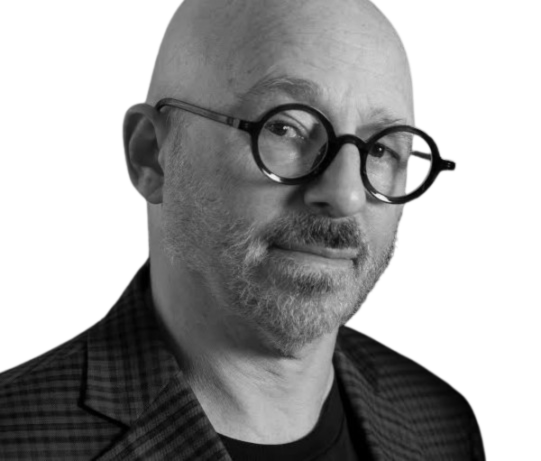
REGIONAL EMMY AWARD-WINNING AUTHOR AND FILMMAKER STEVEN ROSENBAUM insists that AI-generated quotes in his 2026 book, The Future of Truth: How AI Reshapes Reality, were an ‘accident.’ But Wikipedia editing logs show that he was once accused and warned about the exact same behaviour, while potentially hiding a conflict of interest.
“I’m not a regular Wikipedia contributor, and when it became clear that the submission and conflict-of-interest rules were more complicated than I understood, I dropped it,” Rosenbaum tells me.
As a freelance investigative journalist, it’s always exciting when one of my scoops lands in the pages of a big newspaper or a book. Well, almost always.
One exception is Steven Rosenbaum’s splashy AI polemic, The Future of Truth: How AI Reshapes Reality, which The New York Times recently described as “a nonfiction book about the effects of artificial intelligence on truth” but which “included numerous made-up or misattributed quotes concocted by A.I.”
The Times exposé cites many examples of AI fabulism seemingly prompted by Rosenbaum, including fabricated quotes attributed to Kara Swisher and Northeastern professor Lisa Feldman Barrett. Browsing the book yesterday, I discovered it also credits my own Buzzfeed News exposé of serial plagiarist David Mikkelson—better known as the co-founder of fact-checking site Snopes—to someone else entirely.
How the f*ck did this happen? Speaking to the Times in May, Rosenbaum claimed that the inclusion of AI-generated quotes was an “accident” and he had “no intention of fabricating any viewpoints.” WIRED, which earlier that month published a since-retracted excerpt of Rosenbaum’s book, paints an equally incomplete picture, with Rosenbaum evading inquiries by reporter Kate Knibbs. Here’s a snapshot from Knibbs’ article:
After the Times story broke, WIRED took another look at our 1,450-word excerpt…
WIRED ran the excerpt through several AI-detection services, including Pangram, GPTZero, and ZeroGPT. Each service suggested that it was either likely AI-generated, or AI-generated with high confidence. But AI-detection tools are fallible, and can return inaccurate readings. So WIRED’s head of research emailed Rosenbaum directly to ask if and how he had used AI to write the excerpt…
Rosenbaum would not weigh in on the accuracy of Pangram’s results. In fact, he didn’t want to talk about them at all. “I don’t participate in that conversation,” he said. “It’s like saying, do you beat your wife? It’s one of those accusations that there’s no response to.”
Unhappy with that explanation, I looked around for contextual clues that might help shine a light on Rosenbaum’s writing approach. It wasn’t long before I found one—in Wikipedia of all places. (This blog has scooped numerous examples where controversial public figures like Russian spy Maria Butina and former Trump aide Michael Caputo tried to remove possibly incriminating and embarrassing information about themselves and their work.)
Meet “SteveMagnifyMedia,” one of three linked sockpuppet accounts that also include “SteveMagnify” and “Pamyoder” (the name of Rosenbaum’s wife), and which exploited Wikipedia’s open collaborative model to promote Rosenbaum, his work, and his companies Magnify Media and the Sustainable Media Center.
Editing logs show that in March 2025, over a year before Rosenbaum’s book scandal broke, two editors accused “SteveMagnifyMedia” of using AI to draft a potentially error-laden bio for Emma Lembke, a board member at Sustainable Media Center, while a third accused him of potentially breaking the site’s rules around undisclosed conflicts of interest by editing his own page.
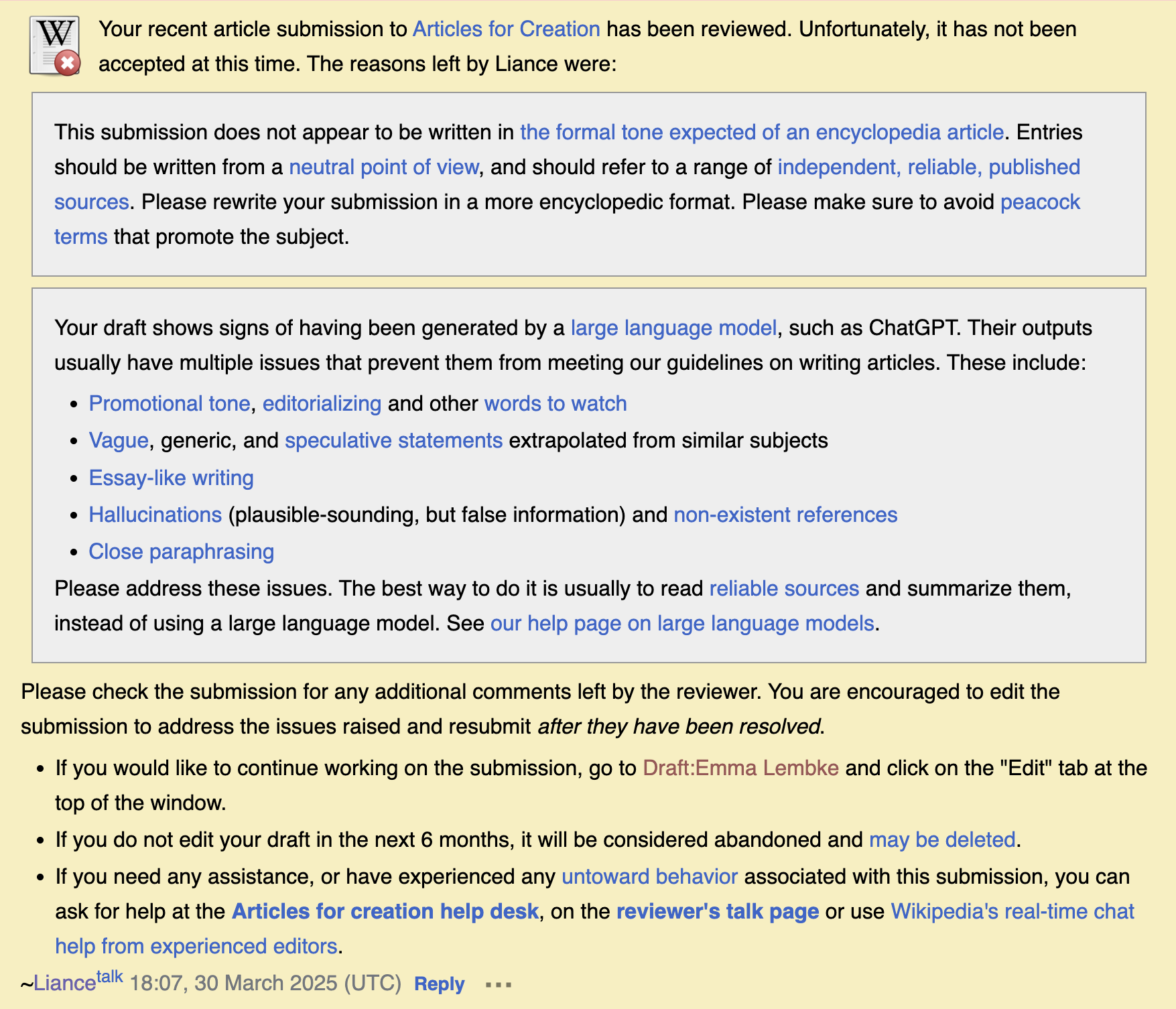
The bio was rejected by two separate Wikipedia editors because, quote, “your draft shows signs of having been generated by a large language model, such as ChatGPT” and possibly included AI-generated hallucinations.
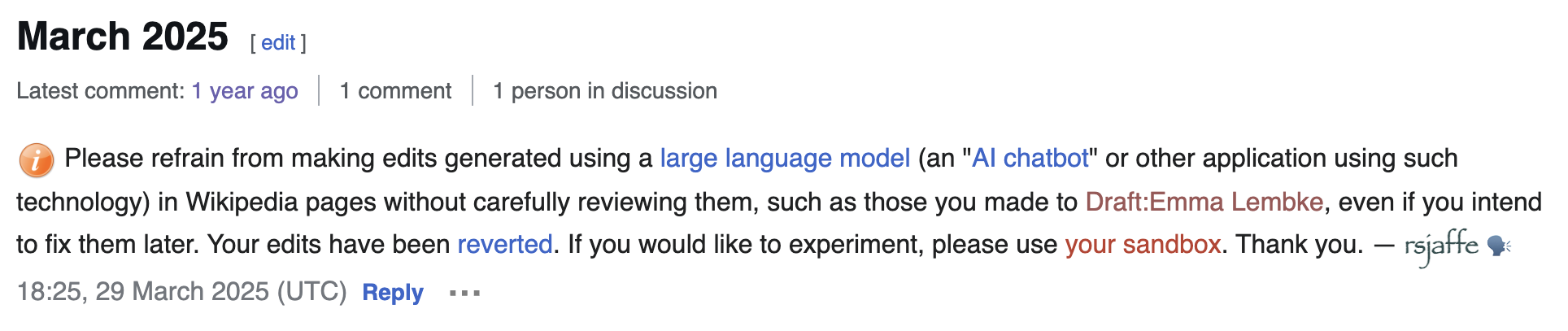
The first accusation was made on March 29, 2025 by an editor named “rsjaffe,” who warned Rosenbaum:
“Please refrain from making edits generated using a large language model (an ‘AI chatbot’ or other application using such technology) in Wikipedia pages without carefully reviewing them, such as those you made to Draft:Emma Lembke, even if you intend to fix them later. Your edits have been reverted. If you would like to experiment, please use your sandbox. Thank you.”
Another editor, “Theroadislong,” then slapped Rosenbaum with a warning:
“The nature of your edits gives the impression you have an undisclosed financial stake in promoting a topic, but you have not complied with Wikipedia’s mandatory paid editing disclosure requirements.”
A third accusation came the following day via “Liance,” who noted that the now-deleted bio may have included AI “Hallucinations,” described as “plausible-sounding, but false information” containing “non-existent references.” This editor noted other potential problems such as “Promotional tone” and “close paraphrasing” of other people’s work.
Asked via email whether he’d used sockpuppets to publish error-ridden AI content on Wikipedia, Rosenbaum replied:
“I noticed Emma didn’t have an entry and thought she deserved one (Google her, she’s amazing.) I’m not a regular Wikipedia contributor, and when it became clear that the submission and conflict-of-interest rules were more complicated than I understood, I dropped it.”
That’s one mystery solved. Now back to how I got dragged into this.
At first, I was flattered to see my work featured by Rosenbaum, whose book briefly details my 2021 BuzzFeed News scoop, outing Snopes co-founder David Mikkelson as a plagiarist and fabulist. However, I quickly curbed my enthusiasm when I discovered my story had been misattributed to New York Times journalist Katie Robertson. Not only that, the book’s sole credit of my work used words lifted near-verbatim from another Times journalist’s coverage of the story.
The book’s bibliography contains two incorrect citations around this subject, both of which direct readers to the Times’ reporting. The first credits Times journalist Sapna Maheshwari rather than Heather Murphy, who actually wrote the article; the second credits Katie Robertson, who has seemingly never written about Mikkelson’s plagiarism. Neither includes the Times’ headline, instead lifting a closely worded variant from my reporting.

Accident? Here’s what Rosenbaum said when asked to account for the various misattributions, false quotes, and uncredited near-verbatim lifting of other journalists’ work:
“You are absolutly correct that your BuzzFeed News investigation broke the David Mikkelson plagiarism story, and the book should have credited your reporting directly. The revised edition had already flagged that in the fact check, and it will be corrected in the revised edition.”
While happy to learn that I’ll receive proper credit in future editions, I couldn’t find a publication date anywhere online. So I took a leaf out of Rosenbaum’s playbook and handed fact-checking duties to a chatbot (you can determine its accuracy).
Quote: “There is no officially announced second edition for Steven Rosenbaum’s book.”
Got a tip? Feel free to drop me a line at deansterlingjones@shootingthemessenger.blog. Feeling generous? I also accept tips via PayPal.

